
Hospitality Section & Tabs
Keyboard shortcut: Ctrl + Alt + A
The Hospitality section is where a user can:
- Manage room records for one or multiple room types, including occupancy and ADR assumptions
- Define line item records (departmental revenues and expenses; undistributed, fixed & FF&E expenses; management fees; and building capital) for a property
- Manage inflation named items
- Define and manage Area Measures for a property
Many of the data inputs in this section of the application rely on the use of input carousels. For instructions on how to use an input carousel, click here.
Article contents:
Rooms
Ctrl + Alt displays the numeric keyboard shortcut.
The Rooms tab is used to model:
- Room inventory, including both # of rooms and square footage per room
- Occupancy rates
- The Average Daily Rate ("ADR")
Rooms Columns
Room Description
Room Description (required) identifies the room type (i.e., 1 King Bed Suite, 2 Queen Beds, etc.) with a 30-character maximum.
Rooms/Area
Rooms/Area (required) is used to enter the total number of rooms (keys) associated with the Room Description and the average area per room for all the rooms included within the Room Description record. If there are rooms of different sizes included within the Room Description record, the average area would be entered here.
Example: A hospitality property has 30 "1 Bed King" rooms, 15 of which are 350 square feet, 10 of which are 400 square feet and 5 of which are 425 square feet. If all 30 units are entered within one 1 Bed King record, the average area to be entered would be 379 square feet. Alternatively, three separate 1 Bed King records could be entered using the exact square footage (i.e., the first record would have 15 units of 350 square feet, the second record would have 10 units of 400 square feet and the third record would have 5 units of 425 square feet).
Press the Enter key to input data in either a Basic or Detailed state.
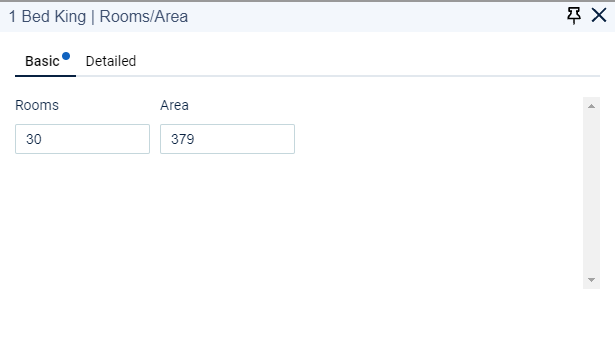
Basic Rooms/Area
Basic Rooms/Area is used when the number of rooms and/or the average area of each room does not change throughout the analysis period.
Rooms is the total number of rooms in the property for the Room Description record.
Area defines the average square footage per unit for the Room Description record.
Basic Rooms/Area
Detailed Rooms/Area
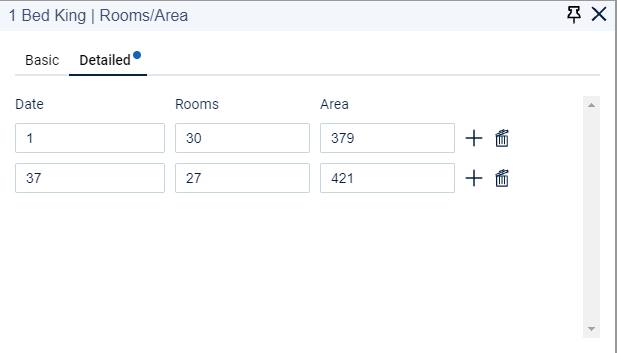
Detailed Rooms/Area is used when the number of rooms and/or the average area of each room changes throughout the analysis period. This would likely be the result of a reconfiguration of the property or construction resulting in additional units coming online.
Date reflects when the number of rooms and/or area per room will change. Relative dates are relative to the Analysis Begin date as entered in the Property section on the Property Settings tab.
Warning: All dates entered for a record must be either absolute or relative. The date type cannot be mixed within a record.
Rooms reflects the number of rooms as of the corresponding date.
Area reflects the average area of each room as of the corresponding date.
 adds a row beneath the current row,
  deletes the current row.
Detailed Rooms/Area
Occupancy
Occupancy (required) is used to define the occupancy rate (expressed as a percentage) for the hospitality property. Occupancy rate is defined as the percentage of available rooms being sold and is calculated as rooms sold divided by rooms available. Each Room Description can have a unique occupancy profile (i.e., a different occupancy rate can by used for "1 King Bed Suite" rooms vs. "2 Queen Beds" rooms).
Press the Enter key to input data in either a Basic, Detailed Annual or Detailed Monthly state.
Basic Occupancy
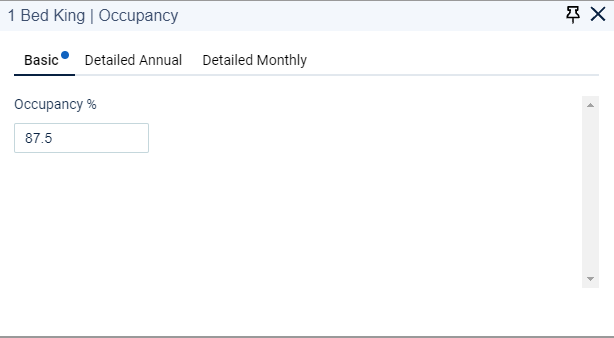
Basic Occupancy is used when the occupancy percentage will remain constant at one rate for the entire analysis term (there is no fluctuation of the rate on either an annual basis or a monthly basis).
Occupancy % is the single occupancy rate that will apply for the room type for the entire analysis period.
Basic Occupancy
Detailed Annual Occupancy
Detailed Annual Occupancy is used when the occupancy percentage will vary on an annual basis (there is no fluctuation of the rate on a monthly basis).
Year reflects the year of the analysis term for which the occupancy rate applies. It is auto-incremented by 1 year as new rows are added and is read-only.
Note: The occupancy assumption for the last year entered will carry through for the remaining years of the Analysis Term.
Amt is the occupancy percentage for the analysis year entered in the Year field.
adds a sequential year beneath the current year, deletes the current year.
Detailed Annual Occupancy

Detailed Monthly Occupancy
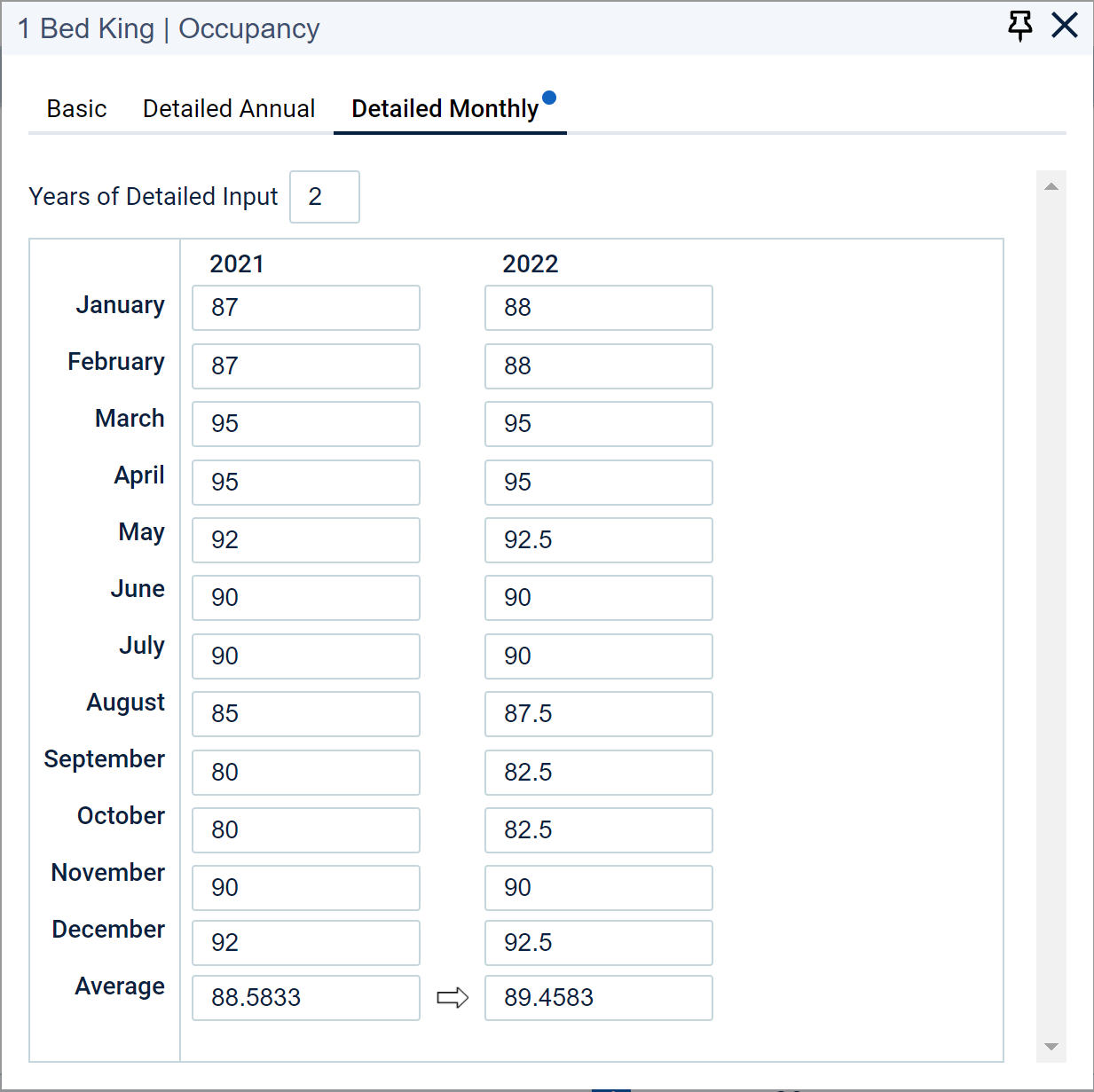
Detailed Monthly Occupancy is used when the occupancy percentage will vary on a monthly basis for a user specified number of years, and is typically used for occupancy that fluctuates during peak and value seasons within a year.
Years of Detailed Input is used to enter the number of years (default = 2; max = analysis term plus 2 years) of detailed entry. Enter the number of years of detailed input, and Tab out or mouse click into another cell. A column will be enabled for each year of detailed input, with each column allowing input on a monthly basis.
Note: The maximum number of years for Detailed entry is equal to the Term specified on the Property Settings tab in the Property section plus two years.
Note: The monthly occupancy assumption for the last year entered will carry through for the remaining years of the Analysis Term.
Enter monthly occupancy rates. This may be accomplished a number of ways:
- Input an occupancy rate for each month within the grid. The Total field will reflect the annual average of the monthly rates entered.
- Input an occupancy rate in the Total field. The monthly rates for that year will be auto-filled by with the same occupancy rate as entered in the Total field.
- Input an occupancy rate for any month and click the down arrow button to the right of the rate entered or use the hot key combination Ctrl + Shift + X. The monthly occupancy rate entered will auto-fill to all subsequent months within that year.
- Populate the monthly occupancy rates for one or more years and click the right arrow button to the right of the annual total for the last year populated or use the hot key combination Ctrl + Shift + X. The average annual rate, with monthly detail, will auto-fill for all subsequent years. For example, if 3 years of detailed input are desired, Year 1 is filled out, and if the arrow button to the right of the annual total for Year 1 is clicked, Years 2 & 3 will auto-fill with the exact annual and monthly detail as Year 1.
Detailed Monthly Occupancy
Average Daily Rate ("ADR")
ADR (required) is a metric used in the hospitality industry to measure the average rate paid for rooms sold and is calculated as the total room revenue for a given period (day, month, year) divided by the total number of rooms sold for the same period. Each Room Description can have a unique ADR profile (i.e., a different ADR can by used for "1 King Bed Suite" rooms vs. "2 Queen Beds" rooms).
Press the Enter key to input data in either a Basic, Detailed Annual or Detailed Monthly state.
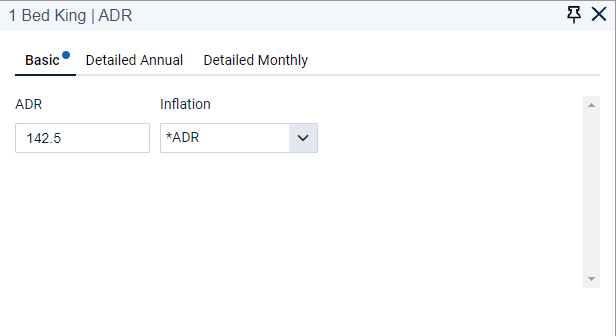
Basic ADR
Basic ADR is used to enter a single Average Daily Rate with optional named inflation.
ADR is the Average Daily Rate as of the Analysis Begin date as set in the Property section on the Property Settings tab.
Inflation is a drop-down menu of named item expedites created and defined in the Hospitality section on the Inflation tab. Upon initial entry, "*ADR" is the default, but can be changed to any named inflation rate. The month on which inflation will be effective is based upon the entry in the Effective Month field on the Inflation tab.
Basic ADR
Detailed Annual ADR
Detailed Annual ADR allows for changing, irregular ADR values on a yearly basis.
Inflation is a drop-down menu of named item expedites created and defined in the Hospitality section on the Inflation tab. Upon initial entry, "*ADR" is the default, but can be changed to any named inflation rate. The month on which inflation will be effective is based upon the entry in the Effective Month field on the Inflation tab.
Note: Detailed Annual ADR will grow at the referenced named Inflation rate commencing with the Year subsequent to the final entry.
Year reflects the year of the analysis term for which the ADR applies. It is auto-incremented by 1 year as new rows are added and is read-only.
Amt is the ADR for the analysis year entered in the Year field.
adds a sequential year beneath the current year, deletes the current year.
Detailed Annual ADR

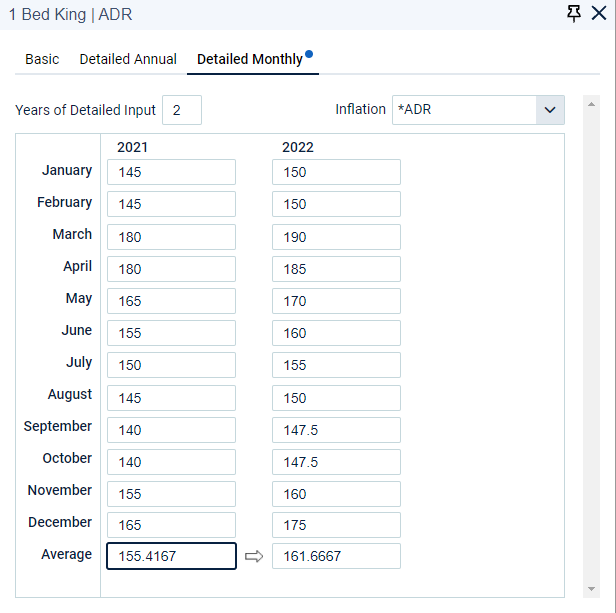
Detailed Monthly ADR
Detailed Monthly allows for changing, irregular ADR values when the Average Daily Rate will vary on a monthly basis for a user specified number of years, and is typically used for ADR that fluctuates during peak and value seasons within a year.
Years of Detailed Input is used to enter the number of years (default = 2; max = analysis term plus 2 years) of detailed entry. Enter the number of years of detailed input, and Tab out or mouse click into another cell. A column will be enabled for each year of detailed input, with each column allowing input on a monthly basis.
Note: The maximum number of years for Detailed entry is equal to the Term specified on the Property Settings tab in the Property section plus two years.
Note: The monthly ADR assumption for the last year entered will grow at the referenced named Inflation rate (see below) commencing with the Year subsequent to the final entry.
Inflation is a drop-down menu of named item expedites created and defined in the Hospitality section on the Inflation tab. Upon initial entry, "*ADR" is the default, but can be changed to any named inflation rate. The month on which inflation will be effective is based upon the entry in the Effective Month field on the Inflation tab.
Enter monthly Average Daily Rates. This may be accomplished a number of ways:
- Input an ADR for each month within the grid. The Total field will reflect the annual average of the monthly rates entered.
- Input an ADR in the Total field. The monthly rates for that year will be auto-filled by with the same rate as entered in the Total field.
- Input an ADR for any month and click the down arrow button to the right of the rate entered or use the hot key combination Ctrl + Shift + X. The monthly rate entered will auto-fill to all subsequent months within that year.
- Populate the monthly ADR for one or more years and click the right arrow button to the right of the annual total for the last year populated or use the hot key combination Ctrl + Shift + X. The average annual rate, with monthly detail, will auto-fill for all subsequent years. For example, if 3 years of detailed input are desired, Year 1 is filled out, and if the arrow button to the right of the annual total for Year 1 is clicked, Years 2 & 3 will auto-fill with the exact annual and monthly detail as Year 1.
Detailed Monthly ADR
Notes
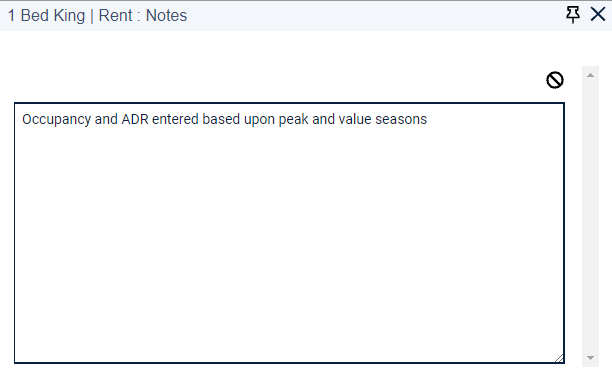
A note can be entered for each Unit Type record on the Rooms tab.
Press the Enter key to activate the Notes field. Enter text for the note.
Use the Clear button  to remove all text.
A blue dot appears next to the word “Notes” when a note exists.

Area & Room Roll-Up Summary

Located at the bottom of the Rooms tab, the area and room roll-up summary provides area/room statistics that may be used to verify that all area/rooms in the building have been properly accounted for within the Rooms screen.
- Area: Total displays the area entered in the *TotalArea field on the Area Measures tab.
- Area: Input displays the sum of total area entered on the Rooms screen (for each Room Type, this amount is calculated as Area x Total Rooms).
- Area: Variance displays the difference between “Area: Total” and “Area: Input”.
- Future Area displays area entered on the Rooms screen that comes online after the Analysis Begin Date.
- Rooms: Total displays the area entered in the *TotalRooms field on the Area Measures tab.
- Rooms: Input displays the sum of total rooms entered on the Rooms screen.
- Rooms: Variance displays the difference between “Units: Total” and “Units: Input”.
- Future Rooms displays the number of rooms entered on the Rooms screen that come online after the Analysis Begin Date.
As a general rule, if area and rooms have been properly accounted for on the Rooms screen, the “Area: Variance” and “Rooms: Variance” should equal 0.
Line Items
Line Items Tab
Ctrl + Alt displays the numeric keyboard shortcut.
The Line Items tab is where line item records for a property are created, defined and edited. This tab is used for the input of all hospitality property expenses (with the exception of Departmental expenses, which are input along with Departmental revenues via the Departmental tab) and building capital. Line Items appearing on this tab will be grouped in the following order by Line Item Type:
- Building Capital
- All Other Expenses (sorted by Acct #)
Acct # is the required account number that has a 20 character maximum and does not accept commas or asterisks.
Name is an optional description with a 50 character maximum. Although optional, the Line Item Name is the description that appears on the Cash Flow report.
Line Item Type determines where the Line Item will appear on the Cash Flow report and is a drop-down menu of types that include:
- Undistributed Expense: These are expenses attributable to the entire hotel and not a specific department. Defined as other expenses directly associated with operations of the hotel but with no corresponding revenue (generally include Administrative & General, Information and Telecom Services, Sales & Marketing, Property Operations & Maintenance and Utilities). Undistributed Expenses are subtracted from "Departmental Profit" on the Cash Flow report to arrive at "Gross Operating Profit Before Fees".
- Fixed Expense: Also known as "Non-Operating Income & Expenses", these are expenses that do not vary with hotel occupancy and are generally unrelated to the operation of the property (generally include Rent, Property and Other Taxes, Insurance and Other Non-Operating Expenses). Fixed Expenses are subtracted from "Gross Operating Profit After Fees" on the Cash Flow report to arrive at "EBIDTA".
- Management Fee: These are fees typically paid to an operator pursuant to a Management Agreement for providing management services. Management fees are typically split into a base fee and an incentive fee. Management Fees are subtracted from "Gross Operating Profit Before Fees" on the Cash Flow report to arrive at "Gross Operating Profit After Fees".
- FF&E Expense: These are expenses related to Furniture, Furnishings or Equipment. FF&E Expenses may be funded by via a reserve into which a fixed percentage of income is paid each month. FF&E Expenses are subtracted from "EBIDTA" on the Cash Flow report to arrive at "Net Operating Income".
- Building Capital: Used to input building level capital expenditures and/or capital reserves. Building Capital items appear below the Net Operating Income line and are subtracted from Net Operating Income to calculate Net Cash Flow. Building Capital is subtracted from "Net Operating Income" on the Cash Flow report to arrive at "Net Cash Flow".
Cash Flow check box indicates whether the line item will affect a property’s cash flow. If checked (the default), the line item will affect the property’s cash flow and if unchecked, the line item will not affect cash flow. A line item will typically be unchecked if such item does not have a direct cash flow impact.

Input Type - See "Line Item Input Types" below.
Cap & Floor
Cap represents a maximum amount for the line item record. Floor represents a minimum amount for the line item record.
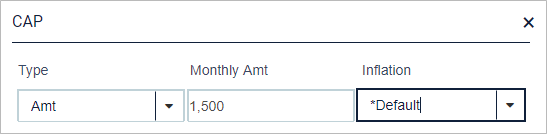
Cap & Floor Type options include:
- Amt - Enter value in Monthly Amt field.
Monthly Amt is the amount of cap or floor expressed on a monthly basis as of the Analysis Begin date.
Inflation is a drop-down menu of named item expedites created and defined in the Hospitality section on the Inflation tab. Inflation is used if the cap or floor increases over time.
Cap Example
A blue dot appears when a Cap or Floor is present.
Use Case: A management fee might be calculated as a specified percentage of Departmental Profit with a minimum monthly amount (e.g., 3% of EGR not less than $5,000/month). In this case, the management fee line item would be set up with a floor to reflect the monthly minimum.
To remove a previously entered cap or floor that is no longer required, click the "Clear" button on the upper right hand corner of the Cap or Floor screen.
Line Item Input Types
Input Types are input methods by which line item detail will be entered.
Press the Enter key to input data using one of the following Input Types:
Amount
Amount is used to enter a whole amount that may be increased by a defined inflation rate.
Amt is the amount of the line item as of the Analysis Begin date. The amount entered here will be interpreted based on the assigned Amt Type.
Amt Type options include:
- Per Mo: Amt value interpreted on a monthly basis.
- Per Yr: Amt value interpreted on an annual basis.
Inflation is a drop-down menu of named item expedites created and defined in the Hospitality section on the Inflation tab. Inflation defines how the line item Amt will grow. Inflation will occur based upon the Effective Month for the assigned Inflation as defined on the Inflation tab. The default value is "*Expense".
Amount Line Item

Amt/Area
Amt/Area is used to enter an amount expressed on a per area basis that is multiplied by a defined Area Measure and may be increased by a defined inflation rate.
Amt is the amount per area of the line item as of the Analysis Begin date. The amount entered here will be interpreted based on the assigned Amt Type.
Amt Type options include:
- Per Mo: Amt value interpreted on a per area, monthly basis.
- Per Yr: Amt value interpreted on a per area, annual basis.
Inflation is a drop-down menu of named item expedites created and defined in the Hospitality section on the Inflation tab. Inflation defines how the line item Amt will grow. Inflation will occur based upon the Effective Month for the assigned Inflation as defined on the Inflation tab. The default value is "*Expense".
Area Measure is a drop-down menu of named items created and defined on the Area Measures tab, accessible from both the Property and Hospitality sections. An area measure is the measurement of square footage or number of rooms by which the Amt value is multiplied to determine the value for the line item.
Use Case: Amt/Area may be used to model variable expenses, whereby an expense rate per area is multiplied by an occupied area measure (square footage or rooms) to determine the total amount of the expense.
Amt/Area Line Item

% Line Item
% Line Item is used to create a line item that is a percentage of:
- (i) one or more existing line items
- (ii) one or more existing departmental line items
- (iii) one or more system line items (line items that are not input by the user but rather auto-defined by rDCF, such as Departmental Profit, Net Operating Income, etc.)
- a combination of (i), (ii) and (iii)
Line Item Type is a drop-down menu that filters the Line Item list.
- "All" lists all Line Item types, both user input and system line items.
- Line Items lists all existing line items.
- Departmental Line Items lists all existing departmental line items.
- System Line Items lists those line items that are auto-defined by rDCF.
Search is a text search box that filters the Line Item list.
Display allows for additional filtering of the Line Item list. Options include:
- All displays all Line Items for the selected Line Item Type.
- Non-zero displays all Line Items for the selected Line Item Type for which the Percent column is not 0 or null.
Line Item is a list of existing Line Items filtered by the selected Line Item Type, Display and/or Search. Each line item is displayed in the following fashion: <Line Item Type>:<Acct# or System Line Item Code>-<Name>.
Percent is the percentage value to be applied to each of the selected Line Items.
% Line Item

Note: The example above shows how a management fee calculated as 5% of Departmental Profit would be entered using a "% of Line" Line Item Type.
Detailed
Detailed is used to enter line items on a monthly basis for a user-specified number of years, after which inflation will commence.
Years of Detailed Input is used to enter the number of years (default = 2) of detailed entry before inflation takes effect. Enter the number of years of detailed input, and Tab out or mouse click into another cell. A column will be enabled for each year of detailed input, with each column allowing input on a monthly basis.
Note: The maximum number of years for Detailed entry is equal to the Term specified on the Property Settings tab in the Property section plus two years.
Inflate From Analysis Begin Date determines whether the detailed amounts entered will be subject to inflation from the Analysis Begin Date using the inflation rate defined in the adjacent Inflation field. If the box is unchecked, the detailed amounts entered will be reflected in each month/year of the analysis at the exact amounts entered on this screen. If the box is checked, the detailed amounts entered will be inflated from the Analysis Begin Date utilizing the inflation rate defined in the adjacent Inflation field.
Inflation is a drop-down menu of named item expedites created and defined in the Multifamily section on the Inflation tab. Line Item inflation will commence in the year subsequent to the last year entered in the detailed line item screen. Inflation will occur based upon the Effective Month for the assigned Inflation as defined on the Inflation tab. The default value is "*Expense".
Note: Inflation will inflate the hard coded amounts entered in the final year of detailed input, maintaining monthly integrity. For example, if the final year of Detailed input is Year 5 and amounts are entered in Months 3, 6, 9 and 12 of Year 5, the Year 5 amounts will be subject to inflation and will appear in subsequent years in Months 3, 6, 9, and 12.
Hint: If you want to "stop" a Detailed input (i.e., make the input zero after a certain number of years), you must add one additional year with all monthly entries of zero. For example, if you want 3 years of Detailed input with zeros thereafter, select 4 years of Detailed input and enter all zeros for Year 4.
Enter monthly amounts for the line item. This may be accomplished a number of ways:
- Input an amount for each month within the grid. The Total field will reflect the annual summation of the monthly amounts entered.
- Input an amount in the Total field. The monthly amounts for that year will be auto-filled by dividing the annual amount by 12.
- Input an amount for any month and click the down arrow button to the right of the amount entered or use the hot key combination Ctrl + Shift + X. The monthly amount entered will auto-fill to all subsequent months within that year.
- Populate the amounts for one or more years and click the right arrow button to the right of the annual total for the last year populated or use the hot key combination Ctrl + Shift + X. The annual amounts, with monthly detail, will auto-fill for all subsequent years. For example, if 3 years of detailed input are desired, Year 1 is filled out, and if the arrow button to the right of the annual total for Year 1 is clicked, Years 2 & 3 will auto-fill with the exact annual and monthly detail as Year 1.
Detailed Line Item
Detailed Per Area
Detailed per Area is used to enter line items on a monthly per area basis for a user-specified number of years, after which inflation will commence. The per area amounts entered are multiplied by an Area Measure as defined by the user.
This Input Type works in an identical fashion to Detailed (see "Detailed" above) with the following two exceptions:
- Monthly amounts are entered as amounts per area rather than as whole dollar amounts.
- There is an additional field for Area Measure, by which the amount per area is multiplied. Area Measure is a drop-down menu of named items created and defined on the Area Measure tab, accessible from both the Property and Hospitality sections.
Detailed Per Area
Detailed % of Line Item
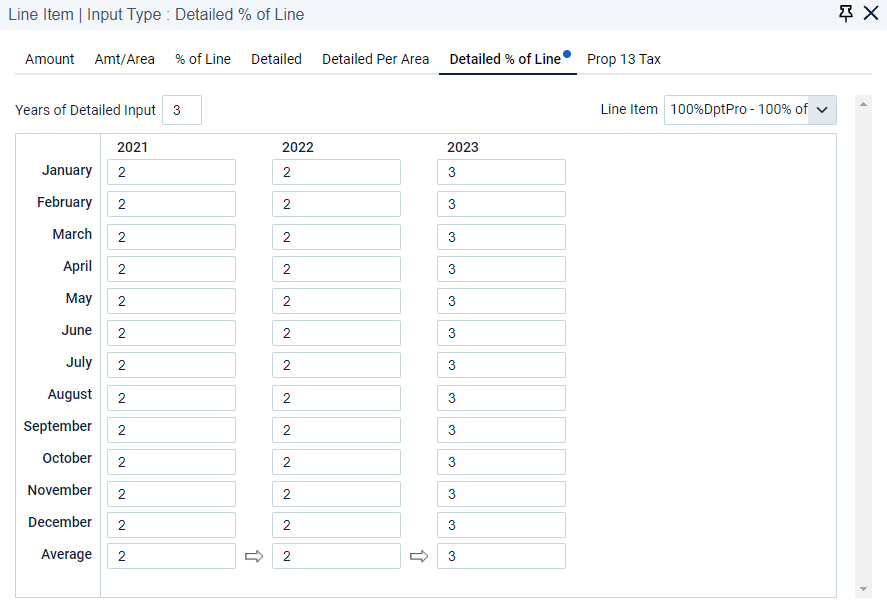
Detailed % of Line Item is used to create a line item that is a changing percentage (either monthly or annually) of one existing line item.
Year of Detailed Input is used to enter the number of years (default = 2) for which a detailed percentage will be entered. Enter the number of years of detailed input and Tab out or mouse click into another cell. A column will be enabled for each year of detailed input, with each column allowing input on a monthly basis.
Note: The maximum number of years for detailed entry is equal to the Term specified on the Property Settings tab in the Property section plus two years.
Select one existing Line Item from the drop-down menu for which a detailed percentage will be applied. The system line items for Departmental Room Revenue and Departmental Room Expense are also available.
Enter percentage values. Each monthly percentage will be multiplied by the corresponding monthly line item amount. Therefore, the annual percentage equivalent should be entered within each monthly field (e.g., for 3%, "3" would be entered for every month rather than “.25”). Data entry may be accomplished in a number of ways:
- Input a percentage for each month within the grid. The Average field will reflect the annual average of the monthly percentages entered.
- Input a percentage in the Average field. The monthly percentages for that year will be auto-filled with the same percentage as the annual Average percentage entered.
- Input a percentage for any month and click the down arrow button to the right of the percentage entered or use the hot key combination Ctrl + Shift + X. The monthly percentage entered will auto-fill to all subsequent months within that year.
- Populate the percentages for one or more years and click the right arrow button to the right of the Average for the last year populated or use the hot key combination Ctrl + Shift + X. The annual average percentages, with monthly detail, will auto-fill for all subsequent years. For example, if 3 years of detailed input are desired, and Year 1 is filled out, if the right arrow button to the right of the annual total for Year 1 is clicked, Years 2 & 3 will auto-fill with the exact annual and monthly detail as Year 1.
Hint: If you want to stop a Detailed % Of Line input (i.e., make the percentage input zero after a certain number of years), you must add one additional year with all monthly entries of zero. For example, if you want 3 years of detailed input with zeros thereafter, select 4 Years of Detailed Input and enter all zeros for Year 4.
Note: The Line Item field only allows for the selection of one previously created Line Item (or system line item for Departmental Room Revenue and Departmental Room Expense). Existing Line Items may not be combined here (unlike the functionality for % Line Item entries). If you would like to create a Detailed % of Line Item using System Line Items or a combination of existing Line Items:
- Create a % of Line Item that does not impact cash flow utilizing the proper percentage of the System Line Item(s) and/or existing Line Item(s) (this will typically be 100%).
- Select the newly created Line Item in the "Line Item" field on the Detailed % of Line Item screen.
Example: The management fee for a building is projected to be 2% of Departmental Profit in Years 1 and 2 of the analysis, changing to 3% of Departmental Profit in Year 3 and thereafter. Steps to create this are as follows:
- Add a Line Item that does not impact cash flow using the "% Line Item" carousel state that is equal to 100% of Departmental Profit.
- Add a second Line Item that does impact cash flow using the "Detailed % of Line Item" carousel state. Enter "3" for Years of Detailed Input, select the Line Item created in step 1 from the "Line Item" field drop-down menu, and enter "2" in every month for Years 1 and 2 and "3" in every month in Year 3.
Detailed % of Line Item
Prop 13 Tax
Prop 13 Tax is used to establish real estate tax expense amounts for (i) year 1 of the rDCF analysis based upon the Analysis Begin Date entered in the Property section on the Property Settings tab; and (ii) the year subsequent to the Valuation Term (i.e., hold period) as entered in the Property section on the Valuation Settings tab (this year is often used to calculate the reversion value of a property included in the stream of cash flows that is discounted to arrive at such property's value).
Proposition 13 applies only to properties located in California and was passed as an amendment to the California Constitution in June 1978. The law established the concepts of a base year value for property tax assessments, and limitations on the tax rate and assessment increase for real property. Under Prop 13, all real property has base year values that are established based upon a reassessment that occurs when there is a change in ownership (or for new construction, as of the date of completion), a cap on increases in the assessed value of no greater than 2% each year (until there is another change in ownership), and a limit on property taxes equal to 1% of the assessed value (plus additional voter-approved taxes) (SOURCE: Santa Clara County Office of the Assessor website).
The implication of this law for discounted cash flow analysis and valuation is threefold:
- For a property transaction (acquisition or sale), the real estate tax expense needs to be re-set in year one of the new owner's hold period based upon the valuation of the property as of the date of ownership change. If the valuation is based upon the discounting of future cash flows, then the real estate tax expense also needs to be re-set in the year following the hold period to calculate the reversion value of the property.
- For the valuation of a property that is not part of a transaction (i.e., for an appraisal or asset management purposes), although the real estate tax expense does not need to be re-set in year one of the hold period, the expense does need to be re-set in the year following the hold period to calculate the reversion value of the property.
- The real estate tax expense inflation rate should be set at 2% for the entirety of the hold period.
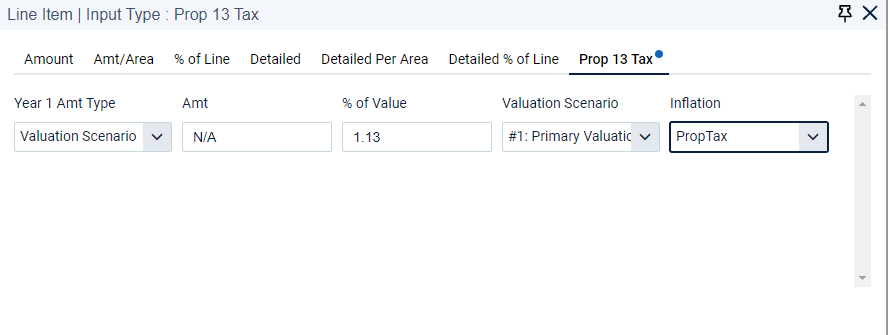
Year 1 Amt Type defines how the real estate tax expense in year 1 will be determined. The available drop-down selections are:
- Valuation Scenario: The year 1 real estate tax expense will be determined by using the valuation assumptions as defined in the "Valuation Scenario" field, and multiplying the resultant value by the percentage entered in the Percent of Value field. If the Valuation Type for the applicable Valuation Scenario is (i) "DCF", then the resultant value will be calculated using the discounted cash flow methodology; (ii) "Direct Cap", then the resultant value will be calculated using the direct capitalization method; (iii) "Specified Price", then the resultant value will be the entered price.
- Amount: The year 1 real estate tax expense amount is entered by the user.
Note: For either Year 1 Amt Type selection, if the Valuation Type is "DCF" or "Specified Price", then a reversion value still needs to be calculated for the year following the hold period (i.e., the reversion year). This value is calculated using (i) the valuation settings entered for the valuation scenario as selected in the "Valuation Scenario" field if the Year 1 Amt Type is set to "Valuation Scenario"; or (ii) the valuation settings entered for the default valuation scenario as determined in the Property section on the Valuation Settings tab if the Year 1 Amt Type is set to "Amount" (even if entered as a valuation setting, cost of sales are excluded from the reversion value in the determination of real estate taxes for the year subsequent to the hold period). If the Valuation Type is "Direct Cap", then no reversion value is calculated for the reversion year and the real estate tax amount continues to increase by the rate entered in the "Inflation" field (see below).
Amount is used to enter the year 1 real estate tax expense if the Year 1 Amt Type is set to "Amount" (if the Year 1 Amt Type is set to "Valuation Scenario" this field is not applicable).
% of Value is multiplied by the (i) initial property valuation when the Year 1 Amt Type is set to "Valuation Scenario"; and (ii) the reversion value to establish the real estate tax expense amounts in (i) year 1 of the rDCF analysis period; and (ii) the year following the assumed hold period, respectively.
Valuation Scenario is a drop-down of the valuation scenarios entered in the Property section on the Valuation Settings tab and is used to define the valuation settings used to determine the year 1 value and the reversion value when the Year 1 Amt Type is set to "Valuation Scenario" (if the Year 1 Amt Type is set to "Amount", this field is not applicable).
Inflation is a drop-down menu of named item expedites created and defined on the Inflation tab. Inflation defines how the Prop 13 expense will grow (as noted above, per California law, this inflation is typically set to 2%).
Helpful Hint: Regardless of the Report Begin Date as entered in the Property section on the Property Settings tab or the Valuation Date as entered in the Property section on the Valuation Settings tab, the calculated year 1 expense will always be assumed to occur in year 1 of the analysis (i.e., the first year beginning on the Analysis Begin Date). If the selected Valuation Scenario uses a different Valuation Date than the Analysis Begin Date, a validation warning will appear. If you wish to use such different Valuation Date, it is recommended that the Inflation applied to real estate taxes be changed to detailed input with 0% growth from the Analysis Begin Date to the Valuation Date to insure that the calculated real estate tax amount for year 1 applies to the first year of the valuation period.
Warning: If an Underwriting Workbook is run for a property that uses Prop 13 Tax to establish the real estate tax expense, and the default valuation assumptions (i.e., cap rate, discount rate, hold period) are subsequently changed within such Underwriting Workbook, the real estate tax expense will not change to reflect the valuation assumption changes. Stated differently, the real estate tax expense in the Underwriting Workbook does not dynamically change as changes are made to the valuation assumptions in the workbook. To see the impact of valuation changes on the real estate tax expense, the user must change the valuation assumptions directly within rDCF on the Valuation Settings tab, recalculate the file, and run the Underwriting Workbook once again.
Prop 13 Tax
Departmental
Departmental Tab
Ctrl + Alt displays the numeric keyboard shortcut.
The Departmental tab is where revenue and expense line item records for the different departments within a hospitality property are created, defined and edited. Typical departments within a hospitality property may include, but are not limited to:
- Rooms
- Food & Beverage
- Retail
- Parking
- Laundry & Valet
- Telephone
- Golf Course
- Spa/Health Club
- Space Rental
- Amenities
- Other
Input for the Departmental tab is similar to Line Items, with the following exceptions:
Record Management
When a new Departmental record is added, two records are created: one for the departmental revenue and a corresponding record for the departmental expense.
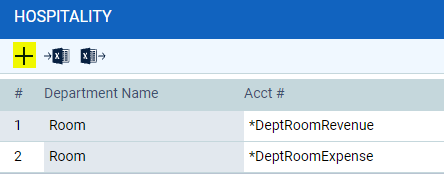
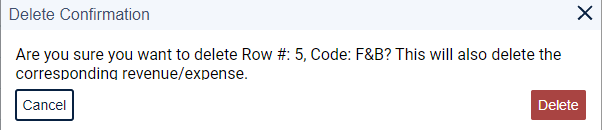
Because the revenue and expense are correlated for reporting purposes, these records are linked together on the interface - deleting or copying either the revenue or expense record results in both records being deleted or copied. Attempting to delete one of the rows will produce the following warning message:
Exception: Room Revenue and Room Expense are required for all hospitality properties. As such, these records appear by default (i.e., they do not need to be added), and may not be deleted or copied.
Department Name
When a Department Name is entered for either the revenue or expense, the same name is used for the corresponding expense or revenue record. If the Department Name for the revenue or expense is subsequently edited, the name for the corresponding expense or revenue record also changes so that the revenue and expense Department Names are always the same.
Exception: The Department Name "Room" for Room Revenue and Room Expense is non-editable.
Acct #
Acct # is the required account number that has a 20 character maximum, does not accept commas or asterisks and must be unique for each departmental revenue and expense.
Exception: The Acct # for Room Revenue defaults to "DeptRoomRevenue" and for Room Expense defaults to "DeptRoomExpense". These defaults are editable by the user.
Line Item Type
Because all records appear within the Departmental section on the Cash Flow report, the Line Item Type for departmental revenues defaults to "Dept. Revenue" and for departmental expenses defaults to "Dept. Expense". These defaults are non-editable by the user.
Exception: The Line Item Type for Room Revenue defaults to "System" as no user entry is required for its calculation.
Cash Flow?
By default, all departmental line items (both revenue and expense) are included on the Cash Flow report. To have a departmental line item not appear on the Cash Flow report, uncheck the box.
Exception: Room Revenue will always appear on the Cash Flow report; therefore, the box defaults to being checked and is uneditable.
Helpful Hint: There may be instances where you would like to enter a revenue line item without a corresponding expense, or vice versa. However, as mentioned above, the departmental revenue and expense records are linked and you cannot delete one without removing the other. To have only one record appear, for the record that you do not want (i) uncheck the "Cash Flow?" box; and (ii) use an Input Type of "Amount" and enter $0 per year.
Input Type
Input Type options for the Departmental tab are exactly the same as Line Items.
Exception: No Input Type is available for Room Revenue. The calculation is automatically performed by the system based upon entries made in the Rooms tab for (i) # of rooms; (ii) occupancy rate; and (iii) ADR.
Exception: For the "% of Line" Input Type, the selections within the "Line Item Type" field dropdown include (i)"All" which lists (a) existing departmental line items (excluding the active departmental line item), (b) existing line items, and (c) System Line Items; & (ii) System Line Items which lists those line items that are auto-defined by rDCF; (iii) existing line items; and (iv) existing departmental line items (excluding the active departmental line item)
NOTE: For Departmental Expenses, the default Input Type is "% Line Item" taking 0% of the parent record Departmental Revenue.
Inflation
Ctrl + Alt displays the numeric keyboard shortcut.
The Inflation tab is used to create named inflation rates that define how inputs grow over time within the analysis period.
Inflation named items are applicable in the following areas of the application:
- Line Items
- Departmental
- Rooms: ADR
There are five (5) named inflations that are automatically included with each hospitality property file:
- *ADR - ADR Inflation
- *BldgCapital - Building Capital Inflation
- *Departmental - Departmental Inflation
- *Expense - Expense Inflation
- *None - No Inflation
These named inflations have (i) a darker gray background in the Code and Name fields, (ii) a Code that is preceded by an "*," and (iii) Codes and Names that are uneditable.
They also have a default Input Type of "Basic" and a default Amt (amount) of "0" which may be edited by the user (with the exception of "*None - No Inflation," which has an uneditable Input Type of "None").
Info: Read about #, Code and Name throughout the Application
Inflation Input Types
Input Types are input methods by which Inflation detail will be entered.
Press the Enter key to input data in either a Basic or Detailed state.
None
*None is the non-editable, system-defined named Inflation (i.e., no inflation). *None should be used when the market assumption is assumed to remain flat throughout the analysis period.
Basic Inflation
Basic Inflation allows for single value that does not change over the analysis period.
Amt is the percentage value inflation rate that is interpreted by the assigned Compound Type. 3% should be entered as "3" rather than ".03".
Compound Type interprets how the value entered in the Amt field inflates the assumption to which it is attached. Options include:
- Annual (default) inflates the assumption to which it is attached on an annual basis.
- Monthly inflates the assumption to which it is attached on a monthly basis by converting the annual Amt entered to a corresponding compounded monthly amount that "trues-up" to the annual inflation Amt on the Effective Month.
Effective Month determines the month upon which the annual inflation value entered will occur (for "Annual" Compound Type) or will "True-up" (for "Monthly" Compound Type). Options include:
- Market Effective Month (default) - Inflation (or true-up) will occur on the month identified as the Market Effective Month in the Property section on the Property Settings tab.
- Any month - Inflation (or true-up) will occur on the month selected.
Example 1:
- Analysis Begin: 1/1/2021
- Market Effective Month: Analysis Begin
- Amt: 3
- Effective Month: Market Effective Month
| Inflation Factor | ||
| Date | Annual | Monthly |
| 1/21 | 1.0000 | 1.0000 |
| 2/21 | 1.0000 | 1.0025 |
| 3/21 | 1.0000 | 1.0049 |
| 4/21 | 1.0000 | 1.0074 |
| 5/21 | 1.0000 | 1.0099 |
| 6/21 | 1.0000 | 1.0124 |
| 7/21 | 1.0000 | 1.0149 |
| 8/21 | 1.0000 | 1.0174 |
| 9/21 | 1.0000 | 1.0199 |
| 10/21 | 1.0000 | 1.0224 |
| 11/21 | 1.0000 | 1.0249 |
| 12/21 | 1.0000 | 1.0275 |
| 1/22 | 1.0300 | 1.0300 |
| 2/22 | 1.0300 | 1.0325 |
| 3/22 | 1.0300 | 1.0351 |
| 4/22 | 1.0300 | 1.0376 |
| 5/22 | 1.0300 | 1.0402 |
| 6/22 | 1.0300 | 1.0428 |
| 7/22 | 1.0300 | 1.0453 |
| 8/22 | 1.0300 | 1.0479 |
| 9/22 | 1.0300 | 1.0505 |
| 10/22 | 1.0300 | 1.0531 |
| 11/22 | 1.0300 | 1.0557 |
| 12/22 | 1.0300 | 1.0583 |
| 1/23 | 1.0609 | 1.0609 |
Example 2:
- Analysis Begin: 1/1/2021
- Market Effective Month: Analysis Begin
- Amt: 3
- Effective Month: July
| Inflation Factor | ||
| Date | Annual | Monthly |
| 1/21 | 1.0000 | 1.0149 |
| 2/21 | 1.0000 | 1.0174 |
| 3/21 | 1.0000 | 1.0199 |
| 4/21 | 1.0000 | 1.0224 |
| 5/21 | 1.0000 | 1.0249 |
| 6/21 | 1.0000 | 1.0275 |
| 7/21 | 1.0300 | 1.0300 |
| 8/21 | 1.0300 | 1.0325 |
| 9/21 | 1.0300 | 1.0351 |
| 10/21 | 1.0300 | 1.0376 |
| 11/21 | 1.0300 | 1.0402 |
| 12/21 | 1.0300 | 1.0428 |
| 1/22 | 1.0300 | 1.0453 |
| 2/22 | 1.0300 | 1.0479 |
| 3/22 | 1.0300 | 1.0505 |
| 4/22 | 1.0300 | 1.0531 |
| 5/22 | 1.0300 | 1.0557 |
| 6/22 | 1.0300 | 1.0583 |
| 7/22 | 1.0609 | 1.0609 |
| 8/22 | 1.0609 | 1.0635 |
| 9/22 | 1.0609 | 1.0661 |
| 10/22 | 1.0609 | 1.0688 |
| 11/22 | 1.0609 | 1.0714 |
| 12/22 | 1.0609 | 1.0741 |
| 1/23 | 1.0609 | 1.0767 |
Detailed Inflation
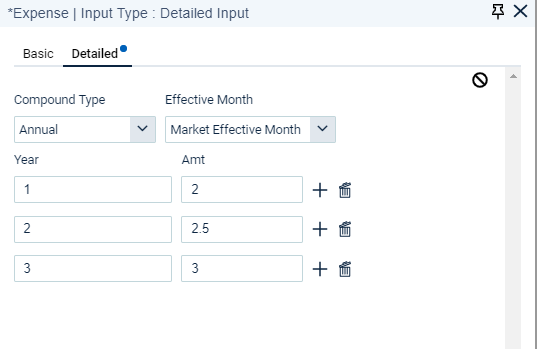
Detailed Inflation allows for changing rates on an annual basis.
Compound Type interprets how the value entered in the Amt field inflates the assumption to which it is attached. Options include:
- Annual (default) inflates the assumption to which it is attached on an annual basis.
- Monthly inflates the assumption to which it is attached on a monthly basis by converting the annual Amt entered to a corresponding compounded monthly amount that "trues-up" to the annual inflation Amt on the Effective Month.
Effective Month
- Market Effective Month (default) - Inflation (or true-up) will occur on the month identified as the Market Effective Month in the Property section Property Settings tab.
- Any month - Inflation (or true-up) will occur on the month selected.
Year is the year of the analysis Term commencing on the Analysis Begin date. It is auto-incremented by 1 year as new rows are added and is read-only. The inflation value entered for the final year of input will continue for the remainder of the analysis.
Amt is the percentage value inflation rate interpreted by the assigned Compound Type. 3% should be entered as "3" rather than ".03".
adds a row beneath the current row, deletes the current row.
Detailed Inflation
Area Measures
Ctrl + Alt displays the numeric keyboard shortcut.
Accessible from both the Property and Hospitality sections, the Area Measures tab is used to:
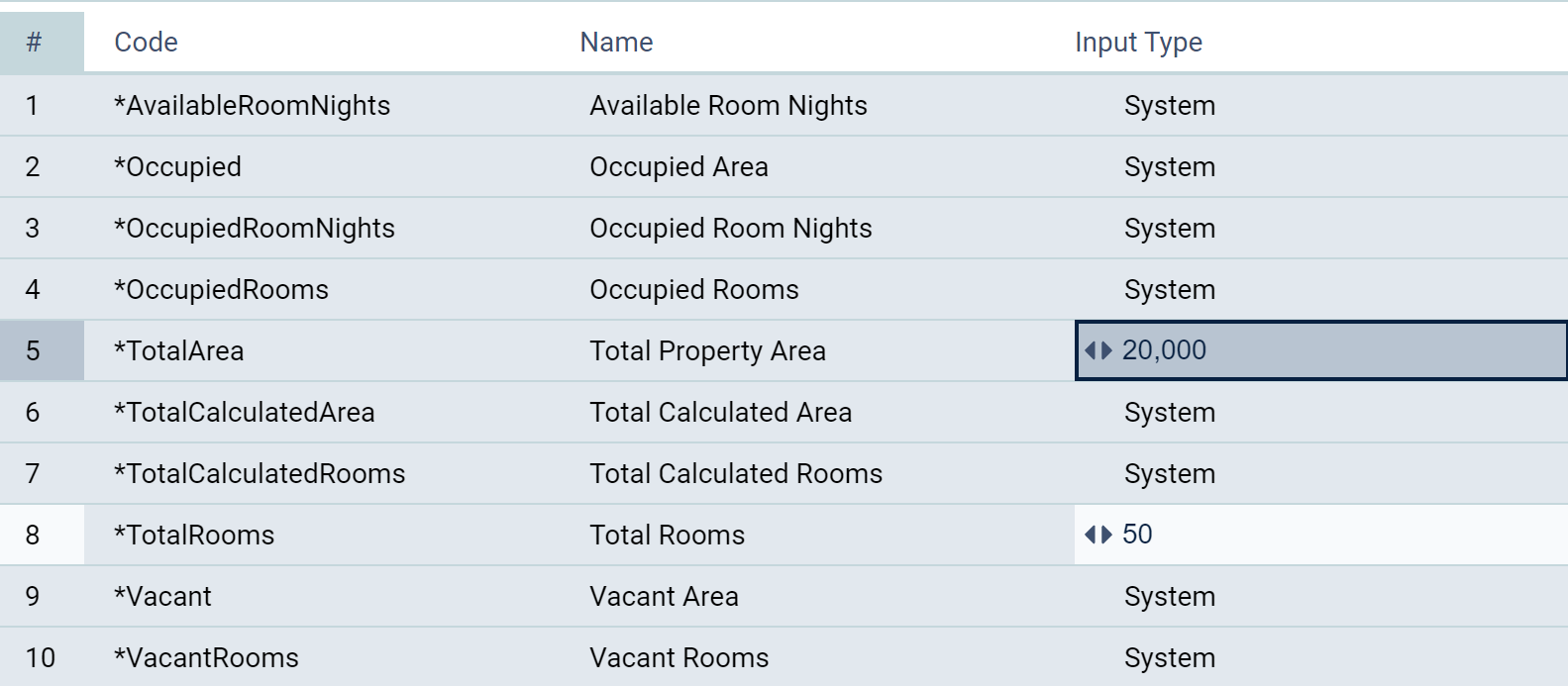
- Define system default area measures (such as *TotalArea - Total Property Area and *TotalRooms - Total Rooms).
- Create named space measurements for Line Item multipliers where the line item is entered as Amt/Area (e.g., occupied area measures used to create variable expenses).
Area Measure named items are referenced via combo box drop-down menus in the following areas of the app (displays the Code):
- Line Items section > Input Type: Amt/Area > Area Measure field drop-down menus
- Line Items section > Input Type: Detailed Per Area > Area Measure field drop-down menus
- Departmental section > Input Type: Amt/Area > Area Measure field drop-down menus
- Departmental section > Input Type: Detailed Per Area > Area Measure field drop-down menus
- Property section > Area Measure tab > Input Type: Percent > Area Measure column drop-down menu
Area Measure Input Types
An asterisk prefix (*) indicates that the item is system defined and grayed-out areas indicate the area measure is immutable (i.e., non-editable system defined).
System
*AvailableRoomNights - Available Room Nights reflectss the number of rooms available for occupancy by guests for a specified period of time (monthly, quarterly or annually) and is calculated as the total number of days in such period (month, quarter or year) multiplied by the total number of rooms. Non-editable system defined (i.e., no user entry).
*Occupied - Occupied Area reflects occupied square footage for the entire property calculated as the total number of occupied rooms multiplied by the area per occupied room. Non-editable system defined (i.e., no user entry).
*OccupiedRoomNights - Occupied Room Nights reflects the number of rooms occupied by guests for a specified period of time (monthly, quarterly or annually) and is calculated as the Available Room Nights in such period (monthly, quarterly or annually) multiplied by the occupancy percentage for that period. If occupancy is entered on a 'Detailed Monthly' basis, then Occupied Room Nights will be calculated monthly and aggregated to arrive at quarterly and annual results. Non-editable system defined (i.e., no user entry).
*OccupiedRooms - Occupied Rooms reflects occupied rooms for the entire property and is calculated as Total Rooms multiplied by the occupancy percentage. If occupancy is entered on a 'Detailed Monthly' basis, Occupied Rooms for a quarter or year reflects the average number of occupied rooms for such period. Non-editable system defined (i.e., no user entry).
*TotalArea - Total Property Area is used to enter the total area of the property (i.e., total Net Rentable Area or Gross Leasable Area) and is typically entered using an Input Type of either Basic (property size remains static for the entire analysis term) or Detailed (property size changes during the analysis term, likely due to re-measurement or new construction).
*TotalCalculatedArea - Total Calculated Area is the sum of the square footage for all rooms entered on the Rooms screen. Non-editable system defined (i.e., no user entry).
*TotalCalculatedRooms - Total Calculated Rooms is the sum of all rooms entered on the Rooms screen. Non-editable system defined (i.e., no user entry).
*TotalRooms - Total Rooms is used to enter the total number of rooms for the property and is typically entered using an Input Type of either Basic (number of total rooms remains static for the entire analysis term) or Detailed (number or total rooms changes during the analysis term, likely due to reconfiguration of existing rooms and/or new construction).
*Vacant - Vacant Area reflects vacant square footage for the entire property and is calculated as Total Area less Occupied Area. Non-editable system defined (i.e., no user entry).
*VacantRooms - Vacant Rooms reflects vacant rooms for the entire property and is calculated as Total Rooms less Occupied Rooms. Non-editable system defined (i.e., no user entry).
Hospitality - System Area Measures
Info: Read about #, Code and Name throughout the app
Press the Enter key to input data using one of the following Input Types:
Basic Area Measure
Basic Area Measures are used when the area measure as entered in the Amt field stays constant for the entire analysis period.
Detailed Area Measure
Detailed Area Measures are used for area measures that change over time during the analysis period.
Date the area measures commences. Enter absolute (A - MM/YYYY) or relative (R - #) dates. Relative dates are relative to the Analysis Begin date.
Amt is the area measure (i.e., square footage or rooms) as of the corresponding date.
 adds a row beneath the current row,
  deletes the current row.
Detailed Area Measure
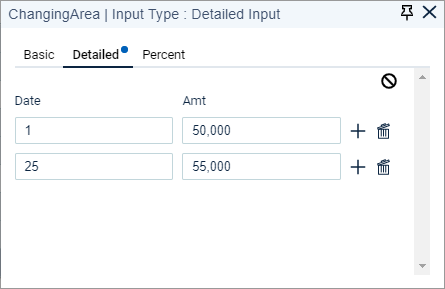
Helpful Hint: Detailed area measures are typically used when (a) a property is re-measured during the analysis period or (b) additional area is added to the property as a result of construction/redevelopment of the property during the analysis period.
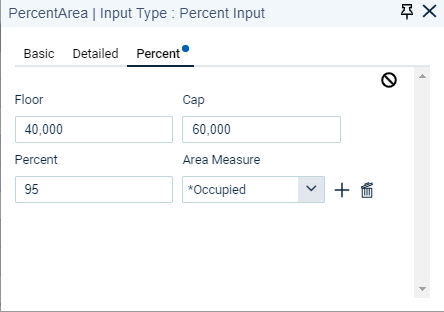
Percent Area Measures
Percent Area Measures are used when an area measure is a percentage of one or more existing area measures and may be constrained by a floor or cap.
Floor (not required) is the minimum area measure value (i.e., the calculated value cannot be less than this amount).
Cap (not required) is the maximum area measure value (i.e., the calculated value cannot be greater than this amount).
Percent is a percentage value (70% is entered as "70", not "0.70").
Area Measure is a drop-down menu of all other Area Measures.
adds a row beneath the current row, deletes the current row.
Percent Area Measure
Comments
0 comments
Article is closed for comments.